

Tibetan Turquoise Jewelry: Meaning, Buying & Care
Tibetan turquoise jewelry is a broad description for ornaments connected with Tibetan design, trade or cultural settings. It does not, by itself, establish a stone’s mine, treatment or age. When choosing a necklace, pendant or bracelet, separate the design story from the material disclosure, then compare construction, fit and care.
What Does “Tibetan Turquoise” Mean?
The phrase can describe a style or cultural association, but it needs a more precise explanation if a seller intends it as a geographic claim. A blue-green colour, dark matrix or antique-looking silver frame cannot establish where a stone was mined. Ask what the seller knows about the stone and what documentation supports the stated origin.
Personal meaning is another layer. You might choose the colour as a reminder of a place, a relationship or a quiet daily habit. That does not establish a universal Buddhist meaning, religious consecration or a promise of protection. If a design includes a named figure, mantra or vajra, learn that motif separately.
Natural Stone, Treatment and Turquoise-Coloured Decoration
These labels describe different things. “Natural” should not be read as a complete treatment statement, and “turquoise-coloured” identifies a colour rather than a mineral. Ask the seller to distinguish the material from its appearance.
| Listing term | What to clarify |
|---|---|
| Natural turquoise | Is the mineral identification supported, and has it been treated? |
| Stabilized turquoise | What treatment is disclosed, and what care does it require? |
| Reconstituted or composite material | What components and binders are used? |
| Turquoise-coloured inlay | What is the inlay actually made of? Colour alone does not identify turquoise. |
GIA describes impregnation treatments that introduce substances such as polymer or wax into porous gems. Disclosure helps you understand what you are buying. It is not useful to classify every treated stone as an imitation, or to assume that an attractive web pattern proves an untreated gem.
How to Choose a Tibetan Turquoise Necklace or Pendant
Start with the material statement, then consider the shape you will actually wear. A Tibetan turquoise necklace may be a short bead strand, an inlaid focal bead or a pendant on a chain. They can share a colour palette while feeling quite different against the neck.
- Check the wearable length. Ask for the full cord or chain range, not only the central bead size. A choker should not be assumed to fit like a long necklace.
- Compare scale. Check pendant height, width and weight against a ruler. A close-up photograph can make a small item look substantial.
- Inspect construction. Look at the bail, bead holes, cord, knots and clasp. Moving parts should operate gently rather than require force.
- Separate metal and stone claims. A silver-coloured setting is not automatically sterling silver. Ask about the alloy and any plating.
- Keep the disclosure. Save the listing and any treatment or origin documents with your receipt.
For a Tibetan turquoise pendant, ask whether the stone is set, glued or part of a composite inlay. Choose according to your routine: a raised setting may catch on clothing, while a short cord needs a comfortable neck fit. Our Tibetan silver guide explains why style names and metal composition need separate checks.
Two KyLin Aura Designs, Two Different Material Descriptions
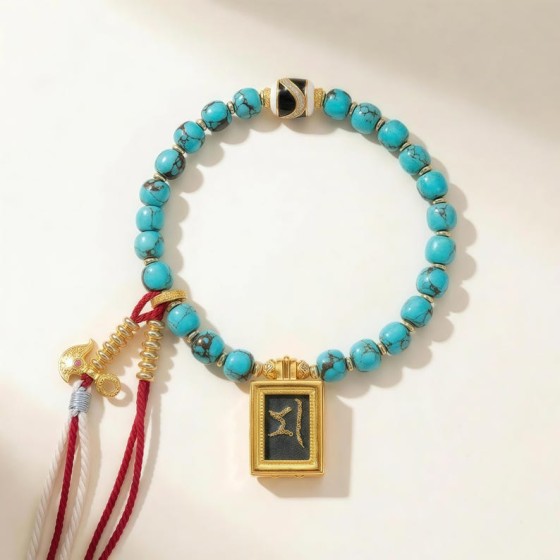
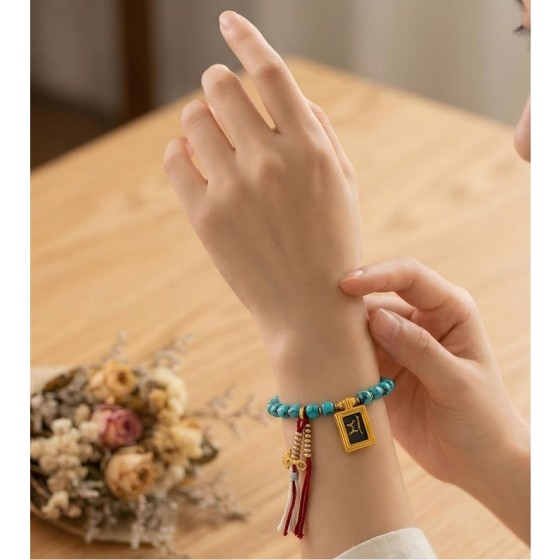
Natural Turquoise Marici Seed Syllable Thangka Bracelet
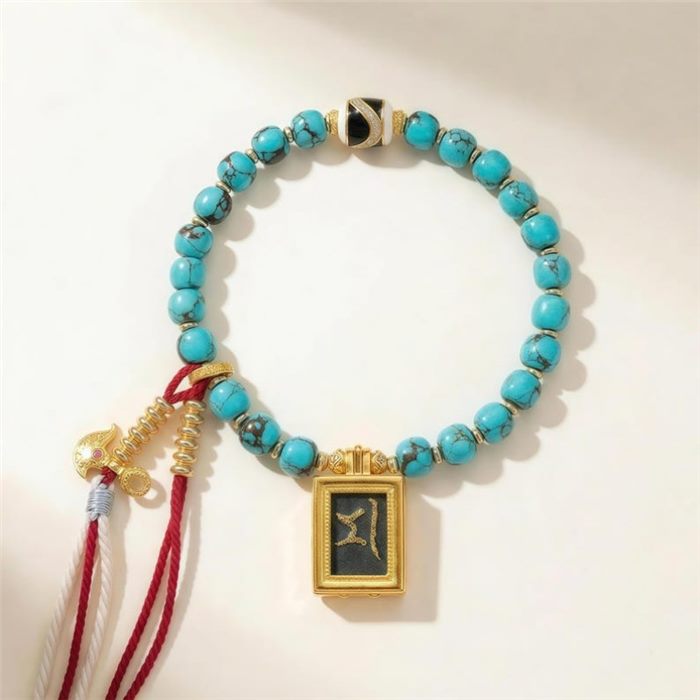
The Natural Turquoise Marici Bracelet is described by the seller as natural turquoise beads with a hand-painted seed-syllable charm and a copper vajra accent. The charm is a syllable design, not a portrait. Ask about any stone treatment, bead dimensions and wrist fit. The listing’s material description is not an independent gem report or proof of Tibetan mining origin.
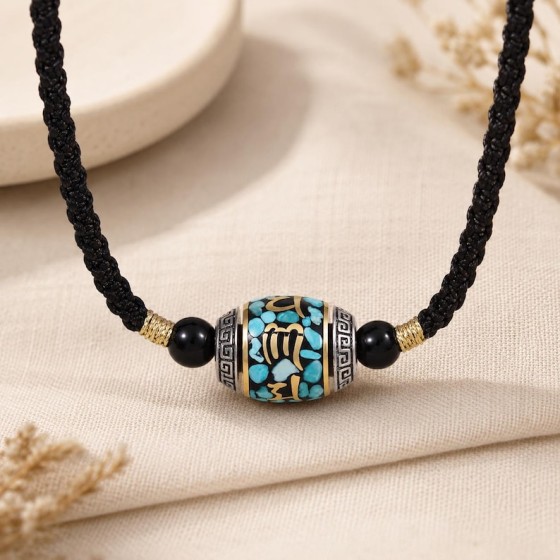
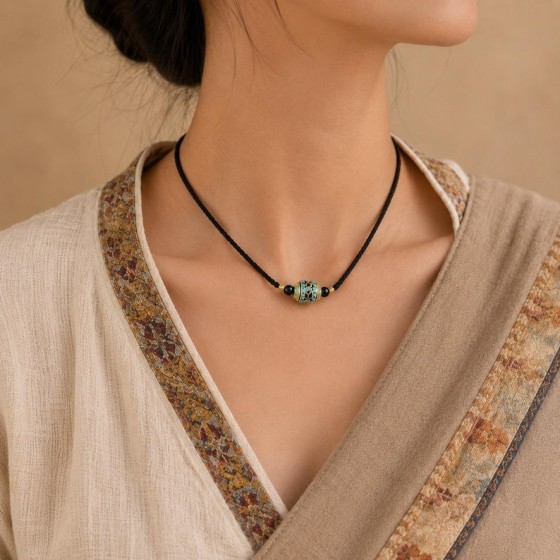
Spinner Turquoise Mantra Necklace
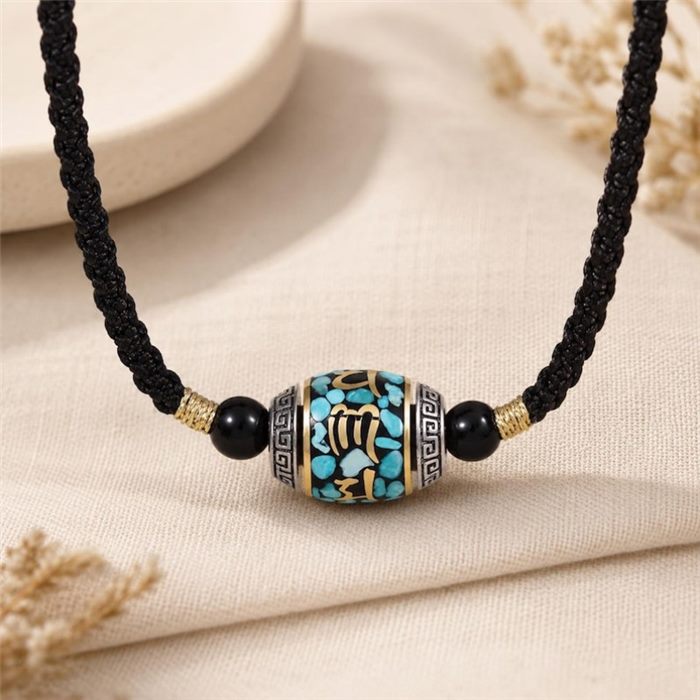
The Spinner Turquoise Mantra Necklace listing specifically describes turquoise-coloured inlay, a Dzi-style rotating centre bead and a dark braided cord. Do not infer natural turquoise or an antique Dzi bead from those style words. Its product video can help you inspect the rotation and profile. Confirm the inlay composition if mineral identity matters to you.
These pieces are useful comparisons because their descriptions differ. Choose the bracelet if its disclosed bead material and construction suit your needs, or consider the necklace for its colour and rotating design. Neither format guarantees a spiritual result.
How to Care for Turquoise Jewelry
Use care instructions for the whole piece, including its cord, paint, plating and adhesive. GIA’s turquoise care guide advises against steam and ultrasonic cleaning and notes that heat and chemicals can affect the stone. Although gentle soapy-water cleaning may suit turquoise itself, do not apply that advice indiscriminately to a painted or mixed-material bracelet.
For the two products above, follow the seller’s more restrictive instructions: avoid water, perfume, sweat and harsh chemicals. Wipe gently with a soft dry cloth, store separately and inspect cords before wearing. Do not use silver dip around a stone or painted charm. Ask the seller before cleaning an unidentified inlay.
Frequently Asked Questions
Is Tibetan turquoise always mined in Tibet?
The label alone does not prove origin. Ask for a specific provenance statement and supporting records if the mining location matters.
Can I identify real turquoise from a photo?
A photo can show appearance and workmanship, but it cannot reliably establish mineral identity or treatment. Do not use scratching, heating or chemical tests on finished jewelry.
Does stabilized mean fake?
Not automatically. Treatment and mineral identity are separate questions. Ask what the material is and how it has been treated.
Can turquoise jewelry get wet?
Follow the maker’s guidance for the complete item. Remove the mixed-material pieces discussed here before bathing or swimming.
Does turquoise guarantee protection or healing?
No. Personal or traditional associations are not evidence of medical or protective effects.
Browse KyLin Aura bracelets, compare formats in our Tibetan bracelet guide, and read what thangka art is used for if your chosen design includes a miniature painting.