

Prayer Wheel Necklace Meaning: Mantra, Use & Buying Guide
A prayer wheel necklace is a wearable pendant inspired by Tibetan Buddhist mani wheels. Many designs feature a rotating cylinder or bead inscribed with Om Mani Padme Hum, a mantra associated with Avalokiteshvara and the cultivation of compassion. Worn respectfully, it can serve as a tactile reminder to pause, recite, breathe, and return to a chosen intention.
The necklace itself does not guarantee protection, healing, merit, or a particular spiritual result. Traditional meaning comes from Buddhist teaching and practice; a modern pendant may be devotional, symbolic, decorative, or a combination of these.
What Is a Tibetan Prayer Wheel?
A Tibetan prayer wheel, often called a mani wheel, is a rotating object that traditionally contains or displays sacred text. Full-size wheels appear in monasteries, temples, pilgrimage routes, and home practice spaces. Practitioners commonly turn them clockwise while reciting or contemplating a mantra, although instructions may vary by lineage and setting.
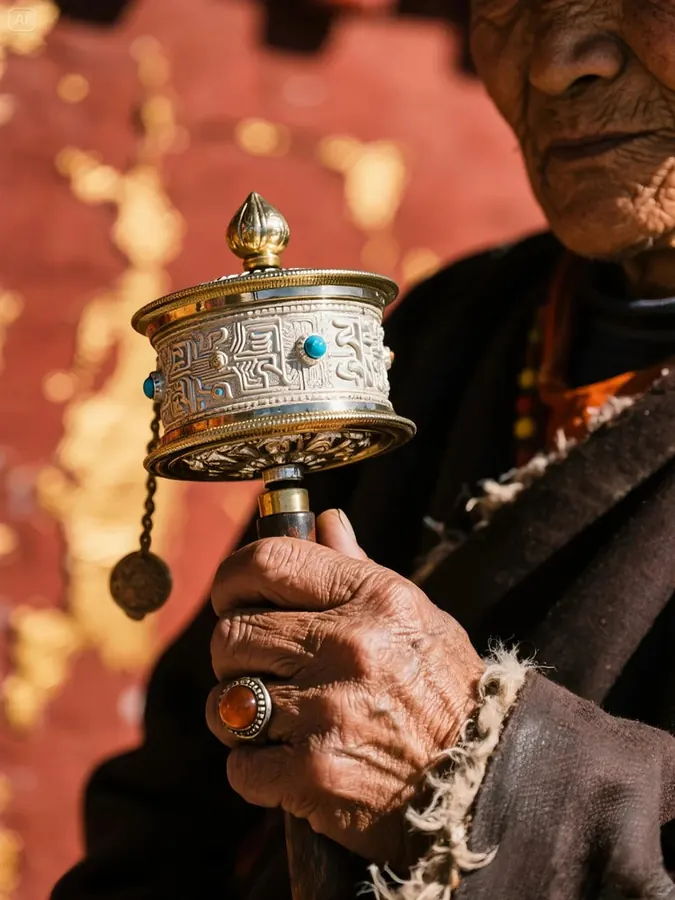
A miniature prayer wheel pendant translates the form into wearable Tibetan-inspired spiritual jewelry. Some pendants rotate on an axle; others use a spinning mantra bead. A moving component alone does not establish that an item has been filled, blessed, or consecrated.
What Does a Prayer Wheel Necklace Mean?
Its central meaning is mindful engagement with Buddhist teachings through movement, mantra, and intention. The circular motion may remind a wearer of continuity in practice, while the inscription points back to the words and values of the mantra. Touching or gently turning the pendant can become a cue to interrupt distraction and respond with greater patience.
| Feature | Traditional or symbolic association | Practical reminder |
|---|---|---|
| Rotating wheel or bead | Repetition and continuity of practice | Pause and return attention to the present |
| Om Mani Padme Hum | Compassion and the Avalokiteshvara tradition | Recite slowly or recall a compassionate intention |
| Circular form | The turning of Buddhist teaching and an ongoing path | Practice consistently rather than seeking instant results |
| Wearable format | Keeping a meaningful symbol close | Create a repeatable daily mindfulness cue |
What Does Om Mani Padme Hum Mean?
Om Mani Padme Hum is among the best-known mantras in Tibetan Buddhism and is closely associated with Avalokiteshvara, the bodhisattva of compassion. Literal word-for-word translations can oversimplify its layered religious meaning. A useful introduction is to understand it as a practice connected with compassion, wisdom, and the aspiration to benefit beings.
If you are learning the mantra as part of formal Buddhist practice, follow guidance from a qualified teacher or your own tradition. If you wear the words as cultural or spiritual jewelry, avoid presenting them as a magical formula or guaranteed remedy.
How to Use a Prayer Wheel Pendant Respectfully
Use it gently and intentionally: pause, turn the moving part without forcing it, and pair the action with a mantra, breath, or compassionate reflection. Traditional prayer wheels are generally turned clockwise, but a necklace's construction and product instructions should also guide how it is handled.
- Morning intention: take three calm breaths, gently turn the pendant, and choose one quality—such as patience or kindness—to remember.
- Mindful pause: during a busy moment, hold the necklace without pulling the chain and silently repeat the mantra.
- Evening reflection: recall one helpful action and one moment in which you could respond more compassionately tomorrow.
Keep the pendant off the floor and away from places where sacred text may be treated carelessly. If a piece is formally blessed or contains a mantra scroll, ask the relevant teacher or community about specific handling.
Prayer Wheel Pendant vs. Spinner Mantra Necklace
| Style | Construction | Best suited to |
|---|---|---|
| Prayer wheel pendant | Vertical wheel-shaped body with a rotating barrel | Wearers who want an obvious mani-wheel form and easy hand access |
| Spinner mantra necklace | Rotating center bead integrated into a cord or short necklace | Wearers who prefer a compact, casual, bead-centered design |
| Non-rotating mantra pendant | Fixed pendant engraved or painted with mantra text | Wearers who value the inscription without a moving mechanism |
KyLin Aura Prayer Wheel and Mantra Necklaces
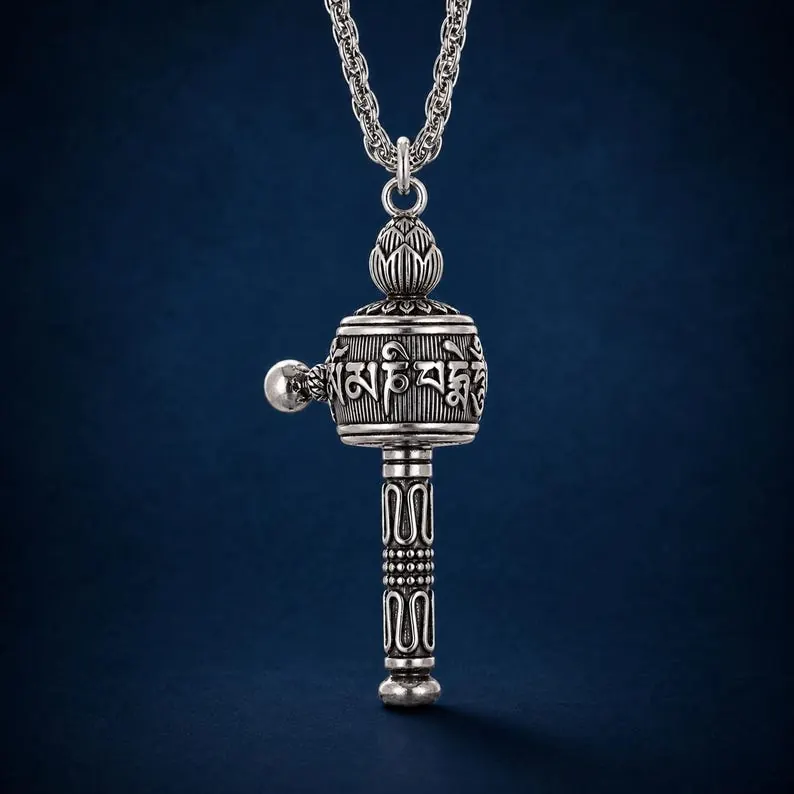
The KyLin Aura Rotating Om Mani Padme Hum Prayer Wheel Necklace has a silver-tone rotating barrel with raised mantra details. Its vertical form closely echoes a handheld mani wheel and works well as an accessible daily mindfulness cue.
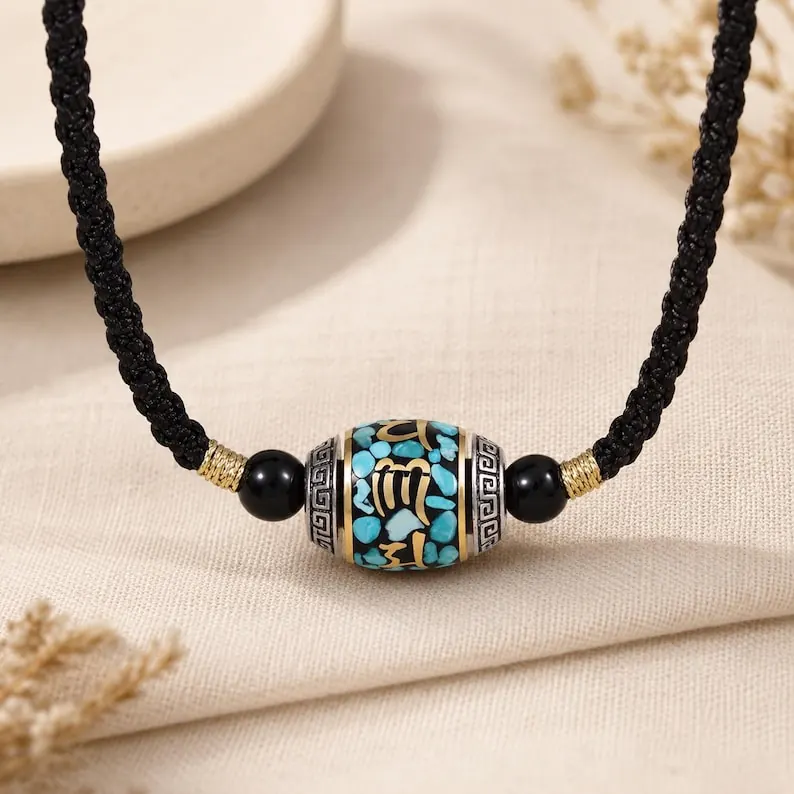
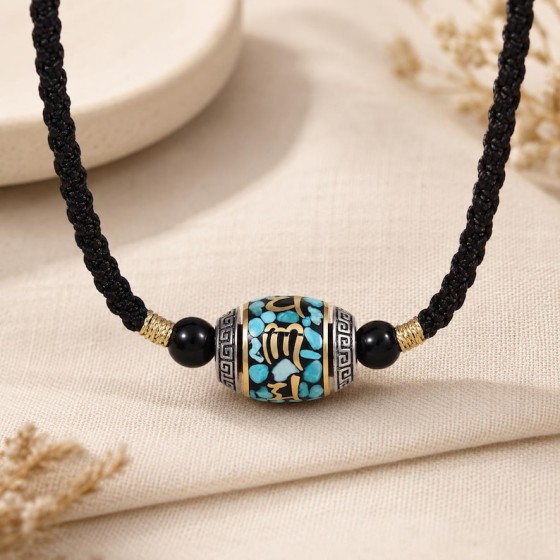
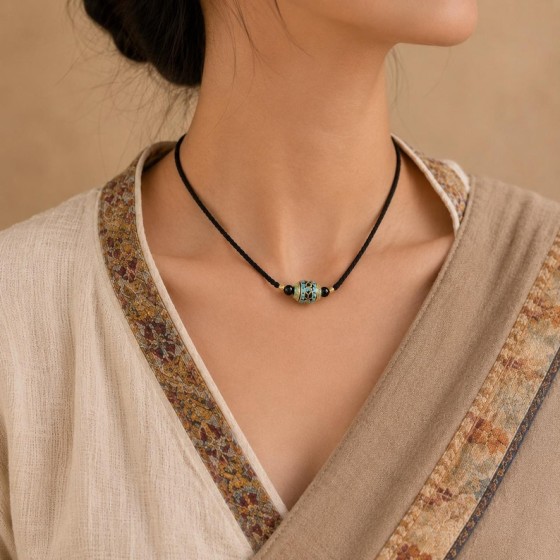
The KyLin Aura Turquoise Spinner Mantra Necklace uses a rotating center bead, turquoise-colored inlay, and braided cord. It offers a shorter, more casual alternative for people who prefer a bead-style mantra necklace.
How to Choose a Prayer Wheel Necklace
- Check the mechanism: it should turn smoothly without scraping, wobbling, or requiring force.
- Read the description: confirm whether the pendant rotates, opens, contains a scroll, or is decorative only.
- Choose a practical length: the pendant should be easy to reach without catching on clothing.
- Inspect the inscription: look for clear, consistent mantra details.
- Consider daily care: keep plated and silver-tone surfaces dry and away from perfume and sweat.
- Respect sacred imagery: choose a design whose meaning you are willing to learn and explain accurately.
Care and Safety
Rotate the moving part gently; do not pull the barrel sideways or use oil unless the maker recommends it. Remove the necklace before bathing, swimming, exercise, or sleep. Wipe it with a soft dry cloth and store it separately. Small moving components are not suitable for young children and should be kept away from pets.
Frequently Asked Questions
Can anyone wear a prayer wheel necklace?
Yes, it can be worn by Buddhists and non-Buddhists when approached respectfully. Learn the symbol's context, avoid exaggerated claims, and do not imply formal blessing or consecration unless documented.
Which direction should a prayer wheel turn?
In Tibetan Buddhist practice, prayer wheels are commonly turned clockwise. Handle a wearable mechanism gently and follow instructions supplied with the piece.
Does a prayer wheel necklace contain a mantra scroll?
Not always. Some traditional wheels contain text, while many modern pendants display the mantra only on the exterior. Check the individual product description.
Can I use it during meditation?
Yes. It can mark the beginning of a session, accompany quiet recitation, or serve as a tactile cue to return attention to the breath. It is a support for practice, not a substitute for instruction.
Is a prayer wheel necklace a protection amulet?
Some wearers connect it with traditional blessing or protection symbolism, but a commercial necklace should not be presented as guaranteeing safety, healing, or supernatural results.
Continue exploring: browse KyLin Aura's necklaces and pendants, read the Kora pilgrimage guide, or learn how to use meditation jewelry and mala beads as everyday mindfulness reminders.