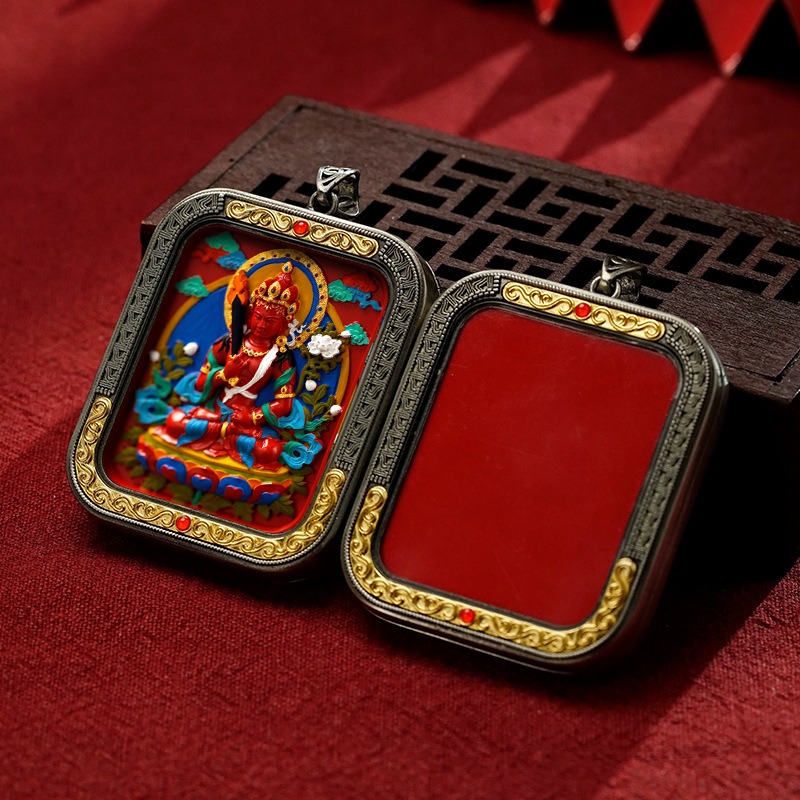


The Sacred Language of Hands: Understanding Buddhist Mudras in Thangka Art and Jewelry
When you look at a Tibetan thangka painting or a piece of Buddhist jewelry, one of the first things you notice is the hands. The fingers of each Buddha or bodhisattva are never casual — every position is deliberate, precise, and charged with meaning. These sacred hand gestures are called mudras (Sanskrit: मुद्रा), and they form a complete symbolic language stretching back thousands of years.
Learning to read mudras is one of the most rewarding keys to understanding Buddhist art. Once you can recognize them, every thangka becomes a text you can read — and every piece of Buddhist jewelry you wear becomes a living symbol of the quality it represents.
This guide introduces the nine most important mudras found in thangka paintings and Buddhist sacred art, beginning with the five classic mudras of Shakyamuni Buddha.
What Is a Mudra?
In Buddhist iconography, a mudra (also called yìnxiāng or yìnqì in Chinese tradition) is a hand gesture or seal that communicates a specific spiritual quality, activity, or state of being. By observing the mudra of a deity, a trained viewer can often identify exactly which Buddha or bodhisattva is depicted — even without seeing other iconographic details.
Mudras are not merely symbolic. In meditation practice, forming specific mudras with one's own hands is understood to activate corresponding qualities in the mind — making them a bridge between outer form and inner experience.
The Five Mudras of Shakyamuni Buddha
1. Vitarka Mudra — The Teaching Gesture (说法印)
The Vitarka Mudra evokes the moment of the Buddha's First Turning of the Wheel of Dharma at Deer Park in Varanasi — the first teaching he gave after his enlightenment. The gesture is formed with the thumb touching the middle finger (or index or ring finger), while the remaining fingers extend naturally. When depicted with both hands, the right hand is raised to chest height with the palm facing outward.
This mudra appears not only in depictions of Shakyamuni, but also in images of Dipankara Buddha, Maitreya Bodhisattva, Manjushri, the great Atisha, and Tsongkhapa — all figures associated with the transmission of wisdom through teaching.
What it communicates: "I am turning the wheel of Dharma. The teaching is flowing."
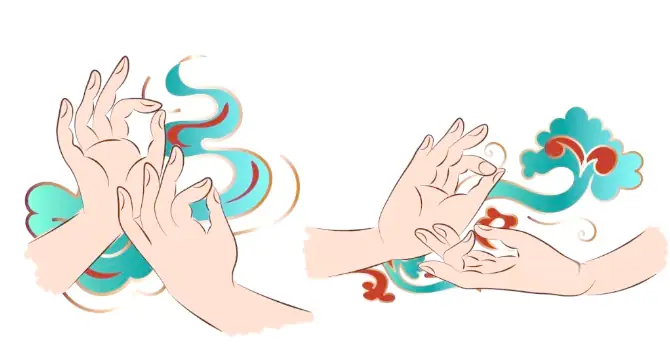
2. Dhyana Mudra — The Meditation Gesture (禅定印)
The Dhyana Mudra represents the deep meditative absorption the Buddha entered beneath the Bodhi tree. Both hands rest in the lap, palms facing upward, with the right hand resting on top of the left, thumbs lightly touching to form an oval. This oval is sometimes said to represent the begging bowl — the symbol of renunciation and simplicity.
Crucially, the right hand always rests above the left. This is said to symbolize that on the path of practice, method must always be supported and guided by wisdom. This mudra is shared by Amitabha Buddha, Amitayus (Buddha of Longevity), and many others associated with contemplative stillness and meditative clarity.
What it communicates: "I am in perfect stillness. All is at rest within awareness."
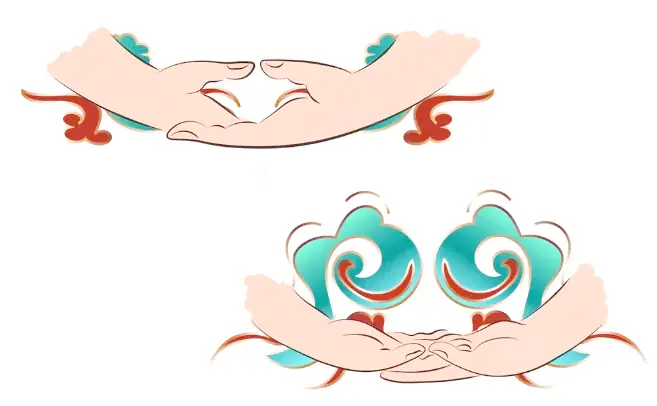
3. Bhumisparsha Mudra — The Earth-Touching Gesture (触地印 / 降魔印)
This is one of the most iconic mudras in all of Buddhist art. The right hand extends over the right knee, fingertips touching the ground — calling the earth itself to bear witness. This gesture commemorates the moment just before the Buddha's enlightenment, when Mara (the personification of delusion and temptation) challenged his right to attain awakening.
Unable to call upon any other witness to his eons of spiritual cultivation and sacrifice, the Buddha touched the earth — and the earth roared in response. Mara was defeated. The darkness dissolved. Only the earth could testify to what the Buddha had given across countless lifetimes for the liberation of all beings.
For this reason, the Bhumisparsha Mudra is also called the Subduing Mara Mudra — a gesture of unshakeable resolve, rooted in the very ground of truth.
What it communicates: "The earth is my witness. My commitment to liberation is absolute."
4. Varada Mudra — The Wish-Granting Gesture (与愿印)
The Varada Mudra is one of the most immediately recognizable gestures in Buddhist art — and one of the most beautiful in its simplicity. The arm extends downward, palm facing outward, fingers gently pointing toward the earth. The open, empty palm is the gesture of unconditional giving: whatever you need, whatever you ask, the hand is open to offer it.
This mudra is frequently paired with the Abhaya Mudra (see below), with each hand forming one of the two gestures. In certain depictions of White Tara, Mahavairocana, and Thousand-Armed Guanyin, the palm of the Varada hand contains an eye — the eye of wisdom that sees the need of every being and knows precisely how to fulfill it.
What it communicates: "Whatever you need, I offer freely. My hand is open. Come."
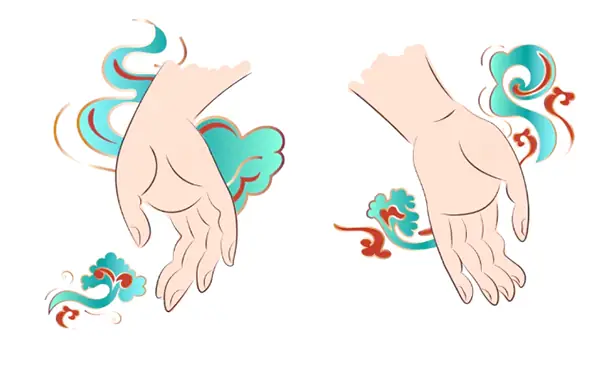
5. Abhaya Mudra — The Fearlessness Gesture (施无畏印)
The Abhaya Mudra — "the gesture that grants fearlessness" — is the raised hand, palm facing outward toward the viewer, fingers pointing upward. It is a gesture of protection, reassurance, and peace: stop, do not be afraid, you are safe here.
Where the Varada Mudra fulfills wishes, the Abhaya Mudra dispels fear. Together, they represent the two fundamental gifts of the bodhisattva: the removal of suffering and the granting of joy. This mudra is associated with Acalanatha (Fudo Myo-o), Vairocana, and many wrathful protective deities — whose fierce appearance combined with this gesture of peace expresses the paradox of wrathful compassion: fierce on the outside, utterly safe within.
What it communicates: "Do not be afraid. I am here. You are under my protection."
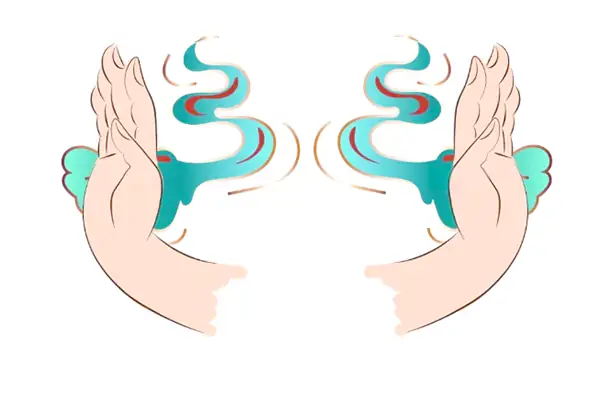
Four Additional Sacred Mudras
6. Anjali Mudra — The Prayer Gesture (合十印)
The Anjali Mudra — hands pressed together at the heart, palms touching, fingers pointing upward — is perhaps the most universally recognized spiritual gesture in the world. In Buddhist iconography, it represents the union of all phenomena within one awareness, the merging of wisdom and method, self and other, samsara and nirvana.
This gesture appears across cultures: in Indian tradition it expresses reverence, respect, and greeting; in Buddhist practice it accompanies offerings, prayers, and prostrations. In sacred art, it is one of the principal mudras of Avalokitesvara (Guanyin) in her many forms — including the Four-Armed Guanyin, Eight-Armed Guanyin, and the Thousand-Armed Thousand-Eyed Guanyin.
What it communicates: "I bring all that I am into reverence before all that you are."
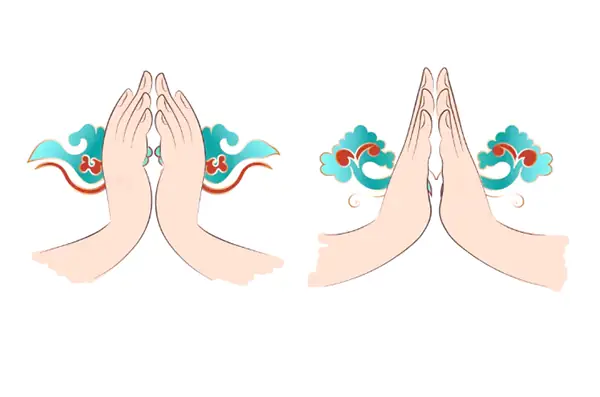
7. Sharana Mudra — The Refuge Gesture (施依印 / 皈依印)
The Sharana Mudra (also called the Refuge Mudra or Dharma Protection Mudra) is formed with the left hand: the thumb lightly touches the tip of one finger (any finger except the little finger), while the remaining three fingers extend upward naturally. This gesture symbolizes taking refuge in the Three Jewels — the Buddha, the Dharma, and the Sangha — the foundational act of Buddhist commitment.
This mudra appears in depictions of Vairocana Buddha, Avalokitesvara, and Green Tara, among others.
What it communicates: "I take refuge. I commit myself to the path of awakening."
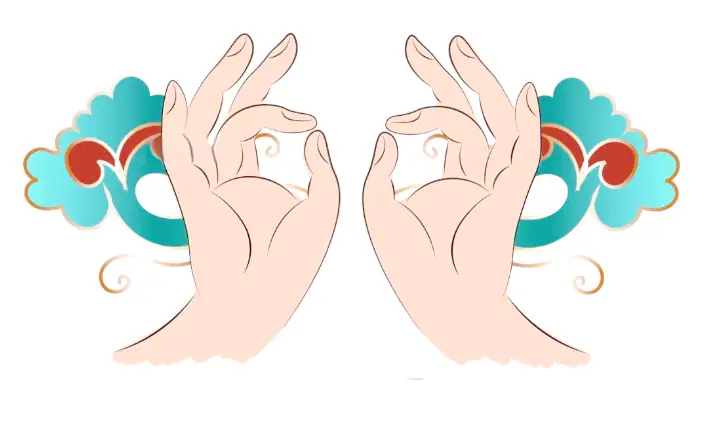
8. Bodhyagri Mudra — The Wisdom Fist Gesture (智拳印)
The Bodhyagri Mudra (also called the Great Wisdom Fist or Vairocana Mudra) is one of the most complex and philosophically dense mudras in all of Buddhist iconography. It is formed by curling the four fingers of both hands around their respective thumbs to create two "vajra fists," then wrapping the right fist around the raised index finger of the left hand and holding this configuration at chest height.
This is the exclusive mudra of Mahavairocana Buddha — the primordial Buddha who embodies the Dharmakaya, the truth body of all Buddhas. The gesture represents the fist of wisdom enclosing the finger of living beings — the interpenetration of Buddha-wisdom and ordinary mind, the realization that what we call "ignorance" is not separate from enlightenment but is enlightenment not yet recognized.
What it communicates: "Wisdom and being are one. The hand of awakening holds all of life within it."
9. Tarjani Mudra — The Wrathful Gesture (期克印)
The Tarjani Mudra is formed with the middle finger and thumb pressed firmly together, the index finger pointing upward — a gesture of fierce warning and subjugation. In Vajrayana (Tantric) Buddhism, this mudra is associated with wrathful deities and Dharma protectors, who wield it to subdue demonic forces, ego-fixation, and the subtle obstacles that block spiritual realization.
When both hands form this gesture and cross at the chest, it becomes the mudra of the Wisdom Kings and Dharma Protectors — who often also hold the vajra bell (symbolizing wisdom) and vajra scepter (symbolizing method) in each hand.
What it communicates: "All obstacles are subdued. The path is cleared. Nothing can block the arising of wisdom."
Why Mudras Matter in Thangka Art and Buddhist Jewelry
Understanding mudras transforms the way you experience sacred art. A thangka is not simply a beautiful painting — it is a precise visual scripture, in which every element of the deity's form encodes specific teachings about the nature of mind, the qualities of enlightenment, and the path of practice.
When you wear a piece of Buddhist jewelry depicting a deity in a specific mudra, you carry that teaching with you. The Abhaya Mudra pendant says: I will not be afraid. The Varada Mudra ring says: I give freely, I hold nothing back. The Dhyana Mudra statue on your desk says: In the midst of everything, I can return to stillness.
These are not superstitions. They are reminders — ancient, tested, and quietly powerful.
Frequently Asked Questions
How do I identify which mudra a thangka is showing?
Focus on the position of the fingers and the orientation of the palm. Is the palm facing outward or inward? Are the fingers pointing up or down? Is one hand above the other, or are they at the same level? These details, combined with the overall posture of the deity, will usually allow you to identify the mudra using this guide.
Can I practice mudras myself during meditation?
Yes. Forming mudras during sitting meditation is a traditional practice in both Tibetan and Japanese Buddhism. The Dhyana Mudra (hands in lap, right over left, thumbs touching) is the most universally accessible starting point — simply forming this gesture while sitting quietly can help settle the mind and deepen concentration.
Every hand tells a story. Every gesture holds a teaching. May these ancient symbols continue to speak — across centuries, across cultures, into the quiet of your own awareness.