


Five Wealth Deities Thangka | Tibetan Buddhist Art Guide
The Five Wealth Deities of Tibetan Buddhism: A Complete Guide to the Sacred Jambhalas
Across the vast landscape of Asian Buddhist tradition, few figures have captured the devotion of practitioners quite like the Wealth Deities — the Jambhalas. From the ancient temples of India to the wind-swept monasteries of the Tibetan plateau, these five radiant beings have been invoked for centuries as guardians of prosperity, protectors against poverty, and guides toward a life of genuine abundance.
In Tibetan Buddhism, there is not one wealth deity but five — each embodying a distinct color, personality, power, and sacred purpose. Together, they form a complete spiritual system for attracting and sustaining wealth in its fullest sense: not merely financial, but also the wealth of health, wisdom, love, career success, and inner peace.
A thangka depicting any of the Five Wealth Deities is among the most auspicious sacred images you can bring into your home or practice space. This guide will introduce you to each deity — their appearance, their origin story, their mantra, and the specific blessings they bring.
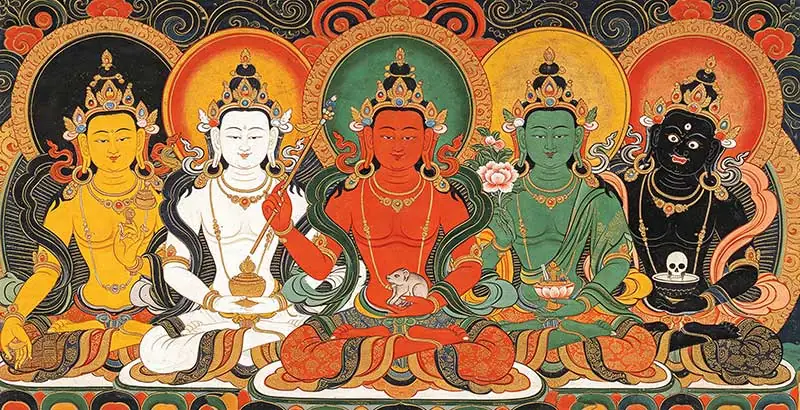
The Yellow Jambhala: Radiant Light of Wealth and Wisdom
Appearance
The Yellow Jambhala's body shines like pure gold — luminous as sunlight, radiating an aura of inexhaustible abundance. He wears magnificent heavenly robes and a Five-Buddha crown studded with brilliant jewels, each gem a symbol of his sovereign status. His face is full and round, his eyes bright and penetrating — expressing both wisdom and compassion. His characteristic round belly and smaller frame carry the beautiful symbolism of a being who can contain all the wealth of the world within himself, sharing it freely with all.
In his right hand, he holds a wish-fulfilling jewel (mani gem) — a radiant gem said to purify all negativity, dissolve illness, and clear karmic obstacles, bringing joy and auspiciousness wherever it shines. His left hand cradles a jewel-spitting mongoose, the ever-present wealth animal of Buddhist iconography, whose mouth pours forth an endless stream of gems and treasures. He sits serenely on a lotus and moon disc throne, one foot resting upon a conch shell — symbolizing his mastery over the ocean's depths and the inexhaustible treasure hidden within.
Origin Story
According to sacred legend, the Yellow Jambhala was once a highly realized bodhisattva who had already attained the profound stages of the path. Long ago, when Shakyamuni Buddha was teaching the Prajnaparamita Sutra on Vulture Peak in Central India, jealous demons conspired to disrupt the teaching. They unleashed dark forces that shattered the very mountain, sending boulders crashing down upon the assembly of monks and the Buddha himself.
In that critical moment, the Yellow Jambhala appeared — fearless, powerful, driving away the demon forces and protecting the Buddha and all who had gathered to receive the teaching. Moved by this act of selfless courage, Shakyamuni Buddha asked him to take refuge in the Dharma and dedicate his power to uplifting all beings suffering in poverty. From that day forward, the Yellow Jambhala vowed to become a great protector of the Buddhist world — helping beings escape destitution and gain both material sufficiency and the inner resources for spiritual practice.
Blessings
- Increases wealth, merit, and material prosperity
- Purifies negative karma that blocks financial flow
- Brings wisdom alongside wealth, ensuring abundance is used well
- Protects against sudden loss and unexpected misfortune
Mantra
Om Zambala Zalendriye Svaha
Practice note: Recite with a generous heart. The Yellow Jambhala is especially responsive to practitioners who cultivate giving — sharing what they have, however little, with those in greater need.
The White Jambhala: Compassion Manifest as Abundance
Appearance
The White Jambhala's body is as pure as freshly fallen snow — white as the unstained lotus, embodying the complete purity and compassion of his origin. For the White Jambhala is none other than a manifestation of Avalokitesvara (Guanyin), the Bodhisattva of Compassion himself. His face carries a semi-wrathful expression, three eyes wide open — the third eye perceiving all suffering hidden from ordinary sight, his powerful gaze bringing that suffering into the light of compassion.
He wears a Five-Buddha crown, its sacred images radiating divine light. His robes are celestial — billowing silk with jeweled adornments, his hair blazing upward like red flames, adding a quality of dynamic spiritual power to his serene compassion. In his right hand, raised toward the sky, he holds a jeweled staff — said to gather the merit of all wealth deities, dispersing poverty and suffering wherever its radiance reaches. His left hand holds the jewel-spitting mongoose and a trident, symbolizing the power to break through all obstacles and rescue beings from the suffering of need. He rides a green dragon — a symbol of renewal, good fortune, and the awakening of latent abundance.
Origin Story
The White Jambhala's origin is one of the most moving stories in the Tibetan tradition. Long ago, the great master Atisha was traveling on pilgrimage to the sacred island of Potalaka — the Pure Land of Avalokitesvara. Along the road, he encountered a man in desperate circumstances: impoverished, ill, and utterly without hope. As a monk, Atisha had nothing material to offer, and his inability to relieve the man's suffering filled him with such grief that tears fell from his eyes.
At that moment, Avalokitesvara himself appeared in human form. Seeing Atisha's compassionate sorrow, and moved by the desperate situation of the poor man, the Bodhisattva wept — two blue tears falling from his eyes. From the tear of his left eye arose Tara, the Swift Liberator. From the tear of his right eye arose the White Jambhala. Avalokitesvara charged the White Jambhala with a solemn mission: to go into the world and relieve the suffering of beings trapped in poverty, bringing them wealth, health, and genuine happiness.
Blessings
- Removes poverty and illness simultaneously
- Purifies karmic debt that perpetuates financial hardship
- Brings gentle, sustained abundance — especially to those in genuine need
- Particularly powerful for health-related financial burdens
Mantra
Om Padma Krodha Arya Zambhala Hridaya Hum Phat
Practice note: The White Jambhala asks that practitioners give generously without expectation of return, and care for those less fortunate. These acts of selfless giving are the fuel that ignites his blessings.
The Red Jambhala: Where Love and Prosperity Flow Together
Appearance
The Red Jambhala's body glows like the dawn sky — rich, warm red radiating a magnetic, joyful energy. His expression is gently fierce: compassionate yet commanding, warm yet powerful. His crown is set with brilliant gems that catch and scatter light in all directions, a fitting adornment for the deity who brings radiance into every area of life.
In his right hand, he holds a mani gem — shimmering with rainbow light, capable of granting wishes and pouring forth both material wealth and heartfelt joy. His left hand cradles the ever-cheerful jewel-spitting mongoose. He stands gracefully on a lotus and moon disc, one leg extended — a posture of dynamic readiness, as if about to step forward to bring blessings directly to you. Most distinctively, the Red Jambhala embraces his wisdom consort (Dakini) — a figure symbolizing the inseparable union of love and prosperity, joy and abundance. The consort holds a skull cup filled with nectar, representing the sweetness of love fulfilled and fortune sustained.
Origin Story
In an ancient village struck by sudden catastrophe — a devastating landslide that destroyed homes and buried farmland — the people were left in despair. A wandering lama arrived and, moved by their suffering, established a sacred Red Jambhala altar in the village square. He led the villagers in sincere prayer and recitation.
As the chanting rose, a brilliant red light appeared in the sky, and within it the Red Jambhala manifested in his full splendor. He exercised his power: the buried fields were restored, crops grew lush and strong, and the damaged homes were repaired. But the Red Jambhala's gift did not stop at material restoration. He brought the energy of love itself into the village — young men and women found their true partners, families were harmonized, and the whole community was filled with laughter and warmth. From that day, the villagers revered the Red Jambhala not only as a wealth deity, but as the bringer of happiness in its fullest, most human sense.
Blessings
- Attracts wealth, love, and harmonious relationships simultaneously
- Brings warmth and joy into the home
- Supports those seeking both financial abundance and emotional fulfillment
- Especially auspicious for new relationships, marriages, and family harmony
Mantra
Om Zambhala Zalendriye Dhana Medha Soha
Practice note: Recite this mantra with a feeling of warmth and openness in the heart. The Red Jambhala responds to genuine positivity and gratitude — the more joy you bring to the practice, the more joy returns.
The Black Jambhala: Fierce Protector Who Turns Misfortune to Fortune
Appearance
The Black Jambhala is the most dramatically powerful of the five. He is a wrathful manifestation of Akshobhya Buddha — the Immovable Buddha of the East — who took this fierce form specifically to lift beings out of poverty and suffering. His body is dark blue-black, representing the ultimate nature of mind: pure, self-arising, beyond the grasping of ordinary thought.
His form is deliberately confrontational: short and powerfully built, large belly, red-black skin, naked, three eyes blazing open, beard and eyebrows the color of fire, adorned with a jeweled crown and a necklace of the Eight Dragon Kings. A great serpent winds across his chest and coils at his belly — adding an atmosphere of awesome, untamable power. In his right hand, raised to his chest, he holds a skull bowl filled with blood — representing the subjugation of all karmic obstacles. In his left, the jewel-spitting mongoose, its mouth containing a wish-fulfilling gem. He stands fiercely upright, one leg bent, one extended, trampling upon a yellow wealth deity beneath his feet — demonstrating complete mastery over all forces of scarcity.
His wrathful appearance is not anger. It is the fierce compassion of a being who sees suffering clearly and acts without hesitation to end it.
Origin Story
In ancient India, the small kingdom of Suvarnadvipa was ruled by the virtuous King Bimbisara — a devoted Buddhist who loved his people and governed with wisdom and peace. But neighboring kingdoms, driven by envy and greed, launched a war against him, plundering his treasury and devastating his people. Not wishing to escalate the violence, the king used his remaining wealth to appease these aggressors — but their demands never ended, and his kingdom was brought to the edge of ruin.
One day, overwhelmed by despair, the king walked to the river's edge, convinced he could no longer save his people. As he waded into the current, a young black child appeared on the bank — no ordinary child, but radiant with hidden power. "I have a way to restore your kingdom's wealth," the child said.
The child pointed to the riverbank: "The sand in that river — that is how much wealth awaits you." In an instant, a magnificent crystal palace appeared before them. "Go into retreat for seven days," the child instructed, "and it will be yours."
The king retreated and practiced with all his sincerity. Seven days passed — nothing visible changed. He returned to the river in confusion. The child told him: "Your mind still clings to appearances. Let go of all that seems real to you." The king retreated again for twenty-one days. When he emerged, the child appeared once more: "You have finally understood — everything you see, including these kingdoms, is a dream." He led the king into the crystal palace, filled to overflowing with all the wealth that had been taken from him.
The black child was the Black Jambhala himself. He had appeared not simply to restore material wealth, but to show the king — and through him, all of us — that the deepest wealth comes from unwavering faith and a compassionate heart.
Blessings
- Especially powerful for those in the deepest financial hardship
- Drives away negative forces, bad luck, and hostile influences
- Protects the marginalized, the lonely, and those who feel without support
- Brings stable, lasting material security and spiritual strength
Mantra
Om Indzali Mukan Dzambhala Svaha
Practice note: Cultivate steadiness and sincerity. The Black Jambhala's blessings are described as "never retreating" for those who hold good intentions — the protection once established does not waver.
The Green Jambhala: Career Success and Expanding Prosperity
Appearance
The Green Jambhala's body shines like polished jade — a vivid, living green that seems to pulse with energy and possibility. He is a manifestation of Akshobhya Buddha, the Buddha of the East, and his color speaks directly of growth: the expansion of business, the increase of wealth, the flourishing of all creative endeavors. He has one face and two arms, three eyes open and clear, wearing a Five-Buddha crown. His celestial robes are threaded with color, his body adorned with precious jewel garlands.
In his right hand, he holds a wish-fulfilling fruit — luminous, overflowing with the power to fulfill aspirations and bring projects to successful completion. His left hand holds the jewel-spitting mongoose, as always, a symbol of good fortune flowing freely. He sits in the posture of royal ease, one foot resting lightly on a white conch shell — representing the purification of obstacles and the creation of a clear path forward. His mount is a green divine horse, galloping with unstoppable swiftness — embodying the speed with which he brings opportunities and fortune to those who call upon him.
Origin Story
In a modern city, a young entrepreneur carried a dream: to build something meaningful, something that would last. But the road was brutal — fierce competition, funding shortfalls, betrayal by partners. He was close to giving up entirely.
On the advice of a mentor, he visited an ancient temple and stood before a statue of the Green Jambhala. Something moved inside him as he looked at that jade-green form — a feeling he couldn't name, somewhere between hope and recognition. He offered incense and candles, made a sincere prayer, and left the temple feeling, somehow, lighter.
Weeks later, a chance encounter at a business event introduced him to a seasoned industry leader who was struck by the young man's sincerity and persistence. That mentor connected him with key clients and partners he could never have reached on his own. His business stabilized. Then flourished. Then expanded into markets he hadn't dreamed of entering.
He never forgot what had shifted in that temple. He continued honoring the Green Jambhala throughout his success — and began giving generously to charitable causes, sharing the fortune that had so unexpectedly turned in his favor.
Blessings
- Accelerates career growth and business success
- Opens unexpected doors and attracts the right people at the right time
- Purifies bad luck and obstacles blocking professional advancement
- Brings swift abundance and expanding prosperity in all material endeavors
Mantra
Om Zambhala Zalendraye Svaha
Practice note: Recite with a clear intention and a specific goal in mind. The Green Jambhala responds especially to those who combine sincere practice with diligent, wholehearted effort in their work.
The Mantras of the Five Wealth Deities: A Practical Reference
Each wealth deity has a root mantra — a sacred sound formula that, when recited with sincerity and a generous heart, opens a channel of connection to that deity's blessings. You do not need to be a formal Buddhist practitioner to begin. What matters is intention: a genuine wish for abundance not only for yourself, but for others.
- Yellow Jambhala — Gold | Wealth & purification of karma | Om Zambala Zalendriye Svaha
- White Jambhala — White | Compassionate abundance & healing | Om Padma Krodha Arya Zambhala Hridaya Hum Phat
- Red Jambhala — Red | Love, joy & magnetizing fortune | Om Zambhala Zalendriye Dhana Medha Soha
- Black Jambhala — Black | Protection & reversing hardship | Om Indzali Mukan Dzambhala Svaha
- Green Jambhala — Green | Career success & swift prosperity | Om Zambhala Zalendraye Svaha
The Five Benefits of Wealth Deity Practice
Across all five Jambhalas, the tradition recognizes a shared set of benefits that arise from sincere and sustained practice:
- Increased Material Wealth — The practice attracts the conditions and opportunities for financial abundance, opening pathways that were previously blocked or unseen.
- Growth of Merit and Virtue — Wealth deity practice is inseparable from cultivating generosity. The blessings of the Jambhalas flow most freely when the practitioner gives without attachment and acts with genuine care for others.
- Removal of Obstacles — Whether financial hardship, career stagnation, or health burdens — the mantras are said to dispel negative forces and clear the way for things to move forward.
- Wisdom in the Use of Wealth — These practices don't merely attract money; they cultivate the clarity and discernment to use resources wisely, for lasting benefit rather than fleeting gain.
- Peace and Mental Stability — The rhythmic recitation of mantras, combined with focused intention, settles the nervous system and cultivates the inner calm from which sound decisions and genuine opportunity arise.
Choosing Your Wealth Deity Thangka
With five extraordinary deities to choose from, you may wonder where to begin. Here are some practical pointers:
Follow your response. Look at images of all five Jambhalas and notice which one draws your attention, creates a feeling of warmth, or makes you pause. That inner recognition is often the clearest guide.
Match the deity to your current focus:
- If you're seeking general prosperity and want to clear karmic debt: Yellow Jambhala
- If financial hardship is tied to health issues or you want compassionate abundance: White Jambhala
- If love, relationships, and joyful living are as important as finances: Red Jambhala
- If you're in serious difficulty, facing adversity, or need fierce protection: Black Jambhala
- If career growth, business expansion, and swift opportunity are your primary goals: Green Jambhala
Consider a complete Five Jambhala thangka — a single composition depicting all five deities together. This comprehensive depiction invites the full spectrum of prosperity blessings into your space, covering every dimension of abundance simultaneously.
Frequently Asked Questions
Do I need to be Buddhist to use a Jambhala thangka?
No. The wealth deities belong to humanity's shared spiritual heritage. Sincere respect, genuine intention, and a willingness to extend your wish for abundance to others as well as yourself — these are the only requirements.
Where should I place a wealth deity thangka in my home?
Traditionally, sacred images are placed higher than eye level, in a clean area that receives attention and care. Many practitioners place wealth deity thangkas in their home office, studio, or a dedicated altar space. Avoid placing thangkas in bathrooms, on the floor, or in cluttered storage areas.
Can I recite the mantra without a formal initiation?
Yes. The wealth deity mantras are generally considered open teachings — accessible to anyone who approaches them with sincerity and good intention. For deeper practice, formal initiation from a qualified lama is recommended but not required to begin.
May the blessings of the Five Wealth Deities reach you wherever you are. May abundance flow — in your finances, your relationships, your health, and your peace of mind. May what you receive, you share freely.
Om Zambhala Zalendraye Svaha