


Thousand-Armed Guanyin Thangka | Sacred Buddhist Art
Among all the sacred figures depicted in Tibetan Buddhist art, Sahasrabhuja Avalokitesvara — the Thousand-Armed, Thousand-Eyed Bodhisattva of Compassion — stands in a category of its own. Revered as one of the Six Forms of Guanyin and counted among the Four Great Bodhisattvas of Buddhist tradition, this deity has been a symbol of compassion and protection for countless beings across centuries.
A Thousand-Armed Guanyin thangka is far more than decorative art. It is a living icon, a devotional anchor, and the tangible expression of one of humanity's most beautiful spiritual visions: compassion without limits.
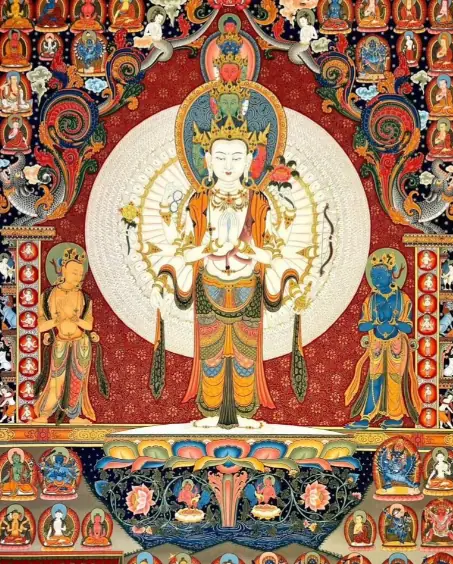
Who Is the Thousand-Armed Guanyin?
Avalokitesvara (Sanskrit: अवलोकितेश्वर) is the bodhisattva who embodies the compassion of all Buddhas. In Tibetan Buddhism, he is known as Chenrezig — one of the most beloved deities in the Himalayan world. In East Asian traditions, he is venerated as Guanyin or Guanshiyin; in Japan, as Kannon. Across every Buddhist culture, this bodhisattva embodies the same essential truth: wisdom and compassion are the two wings of awakening.
The origin of this thousand-armed form traces back to a deeply moving story of vow and sacrifice. Avalokitesvara swore to liberate all sentient beings from suffering. Overwhelmed by the sheer vastness of that task, his body shattered into a thousand pieces — whereupon his teacher, Amitabha Buddha, reconstituted him in a form of even greater power: a thousand arms to reach every being in every realm, and a thousand eyes to perceive every form of suffering.
The Symbolism of the Thousand Arms and Eyes
Every detail of a Thousand-Armed Guanyin thangka carries layers of meaning, carefully preserved across centuries of Buddhist artistic and contemplative tradition.
The Thousand Arms: The Boundless Reach of Compassion
The thousand arms symbolize the infinite breadth of compassion — the capacity to simultaneously reach every being in every realm of existence. No matter where you are, no matter what suffering you face, those arms can find you. In practice, invoking Guanyin's name or meditating upon her image creates a direct and living connection to that boundless compassionate energy.
In traditional iconography, the thousand arms are represented by 42 principal hands: two central palms joined at the heart in prayer, with 20 additional hands on each side — each representing 25, totaling 1,000. Every hand holds a sacred implement: a lotus, a pure-water vase, a dharma wheel, a rescue rope to pull beings from suffering, a wish-fulfilling jewel. Each implement corresponds to a specific act of compassionate intervention.
The Thousand Eyes: Perfect, All-Seeing Wisdom
An eye appears in every palm of every hand, forming the "thousand eyes." These symbolize the perfection of wisdom — an omniscient awareness that perceives the nature of reality and the unique needs of each being. Compassion without wisdom can miss the mark; wisdom without compassion stays cold and distant. In the Thousand-Armed Guanyin, these two qualities are inseparable and complete.
The Meaning of "One Thousand"
In Buddhist cosmology, "one thousand" is not a literal count — it represents totality, completeness, and the infinite. A thousand arms means every possible act of help. A thousand eyes means every possible perception. Together, they express a compassion and wisdom that leaves no being behind.
The Five Sacred Functions: What Each Hand Represents
According to Tibetan Buddhist ritual texts, the 42 symbolic hands of Avalokitesvara correspond to the Five Buddha Families and their associated enlightened activities:
- Pacifying — Calming obstacles, illness, and negative karma; bringing peace to a troubled mind
- Enriching — Increasing wisdom, merit, wealth, longevity, and all positive qualities
- Magnetizing — Drawing love, harmony, and wholesome relationships into one's life
- Subjugating — Overcoming inner and outer obstacles on the spiritual path
- Protecting — Shielding practitioners from harm and negative influences
This is why devotees turn to the Thousand-Armed Guanyin not only in moments of crisis, but as a constant daily presence — a steady source of guidance, protection, and blessings through every turn of life's journey.
Guardian Deity of Those Born in the Year of the Rat
In Tibetan Buddhist and traditional Chinese astrology, each of the twelve zodiac animals is assigned a protective Buddha or bodhisattva as a lifelong spiritual guardian. The Thousand-Armed Avalokitesvara is the guardian deity of those born in the Year of the Rat.
Years of the Rat: 1924 · 1936 · 1948 · 1960 · 1972 · 1984 · 1996 · 2008 · 2020 · 2032
For those born under this sign, a Thousand-Armed Guanyin thangka or pendant carries special personal resonance — strengthening your innate connection to compassionate energy, dissolving obstacles along your path, and amplifying the auspiciousness of your birth year.
That said, the compassionate blessings of the Thousand-Armed Guanyin are not limited to any single zodiac sign. Compassion, by its very nature, makes no distinctions.
Two Classic Traditions of Sacred Depiction
When you encounter a Thousand-Armed Guanyin thangka, it will typically follow one of two classic compositional traditions — each with its own visual power and symbolic emphasis:
The Full Thousand Arms
In this majestic form, all one thousand arms are individually rendered, fanning out behind the central figure like a great peacock in full display. Each arm is meticulously painted, each palm bears an eye, each hand holds a sacred implement. The visual impact is overwhelming in the most sacred sense — a direct, unmediated encounter with power that exceeds ordinary comprehension. Thangkas of this type demand exceptional artistic skill and often require months of dedicated work to complete.
The Forty-Two Symbolic Arms
This more refined and contemplative form depicts 42 arms: two central hands joined in prayer at the heart, with 20 additional arms on each side. Each hand is rendered with fine, detailed brushwork — the implements and mudras clearly articulated, rewarding slow and meditative viewing. Many practitioners find this form more accessible as a focus for visualization practice.
Both traditions are equally sacred and equally valid. The choice between them is ultimately a matter of personal resonance and spiritual affinity.
Thangka: A Living Tradition of Sacred Art
A thangka (Tibetan: ཐང་ཀ་) is not simply a painting — it is a consecrated devotional object, created within an unbroken lineage of sacred artistic practice stretching back over a thousand years. Traditional thangka artists undergo years of rigorous training that encompasses not only technique but also the ritual and meditative dimensions of the craft. Many recite mantras while painting; all follow precise iconometric guidelines drawn directly from sacred texts.
Upon completion, a thangka is typically consecrated by a lama or rinpoche, activating it as a vehicle for the deity's blessings. In this sense, a traditional thangka carries a living spiritual presence — it is not merely a representation of the bodhisattva, but a doorway through which the bodhisattva's compassion and wisdom can flow into your home and practice.
How to Live with a Thousand-Armed Guanyin Thangka
Whether you are a dedicated Buddhist practitioner, an explorer of Eastern spirituality, or simply someone drawn to the beauty and depth of Tibetan sacred art, there are many meaningful ways to welcome a Thousand-Armed Guanyin thangka into your life:
As a Focus for Meditation
Hang the thangka at eye level in a clean, dedicated space. Sit comfortably before it, soften your gaze, and breathe. Let the bodhisattva's presence settle and open your mind. You may silently repeat the compassion mantra: OM MANI PADME HUM — six syllables said to contain the entire teaching of compassion within them.
As a Blessing for Your Home
In Tibetan culture, sacred images are placed in the home to invite positive energy, protection, and auspiciousness. A Thousand-Armed Guanyin thangka in your living space becomes a constant, gentle reminder of compassion's presence — both as a spiritual ideal and as a practical orientation for everyday life.
As a Daily Reminder
Even without formal practice, the daily sight of this sacred image can serve as a quiet invitation: to pause, breathe, and meet the day's challenges with a little more openness and kindness — toward others, and toward yourself.
As a Gift of Profound Meaning
A hand-painted Thousand-Armed Guanyin thangka makes a deeply meaningful gift for milestone moments: a housewarming, a recovery from illness, the beginning of a new chapter, or simply as an expression of love — a wish for another's wellbeing and peace.