


Four-Armed Avalokiteshvara: Meaning, Symbolism & Spiritual Benefits of Chenrezig
Four-Armed Avalokiteshvara: The Bodhisattva of Infinite Compassion and Wisdom
In Tibetan Buddhism, few figures command as much devotion as Avalokiteshvara Bodhisattva — the embodiment of universal compassion. Among his many sacred forms, the Four-Armed Avalokiteshvara, known in Tibetan as Chenrezig, stands as one of the most spiritually significant and widely venerated deities across the Himalayan world. From the towering halls of Potala Palace to the morning chants of Drepung Monastery, Chenrezig's presence is woven into every thread of Tibetan spiritual life.
Whether you are new to Tibetan Buddhism or a seasoned practitioner, understanding the deep symbolism of Four-Armed Avalokiteshvara can transform how you relate to compassion, wisdom, and the path to liberation.
Who Is Four-Armed Avalokiteshvara (Chenrezig)?
Avalokiteshvara is one of the most beloved bodhisattvas in both Tibetan and East Asian Buddhism. In Tibetan tradition, he is depicted in male form — a distinction from the female Guanyin revered in Chinese Buddhism — and appears in numerous manifestations: Two-Armed, Four-Armed, Six-Armed, the Thousand-Armed, and even the wrathful horse-headed Hayagriva.
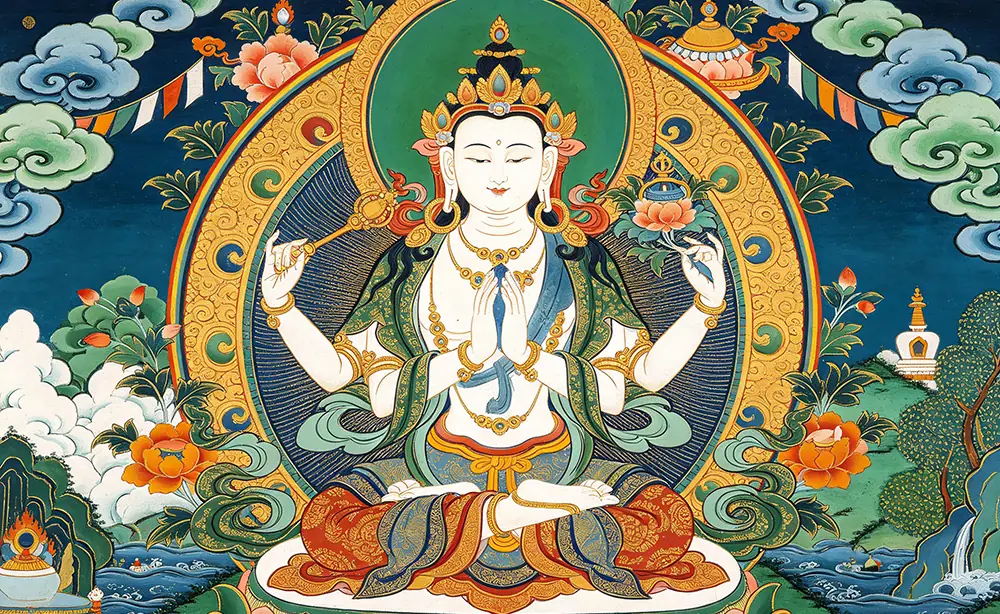
The Four-Armed Avalokiteshvara is the quintessential form in Vajrayana Buddhism. He sits upon a lotus throne in a state of serene meditation, his white body symbolizing the complete purification of karmic defilements. His compassionate gaze reaches every corner of existence, his gentle smile radiating boundless kindness to all sentient beings without exception.
In Tibetan culture, Avalokiteshvara holds a unique cosmic role: the Dalai Lama is traditionally regarded as his human incarnation, and the sacred Potala Palace in Lhasa — "Potala" being the Tibetan rendering of Mount Potalaka — is considered his earthly abode. Each morning at Drepung Monastery, monks begin their day with the invocation: "Mimidzewa Detsen Gyaltsen" — "May Avalokiteshvara bless us with peace."
The Symbolism of the Four Arms
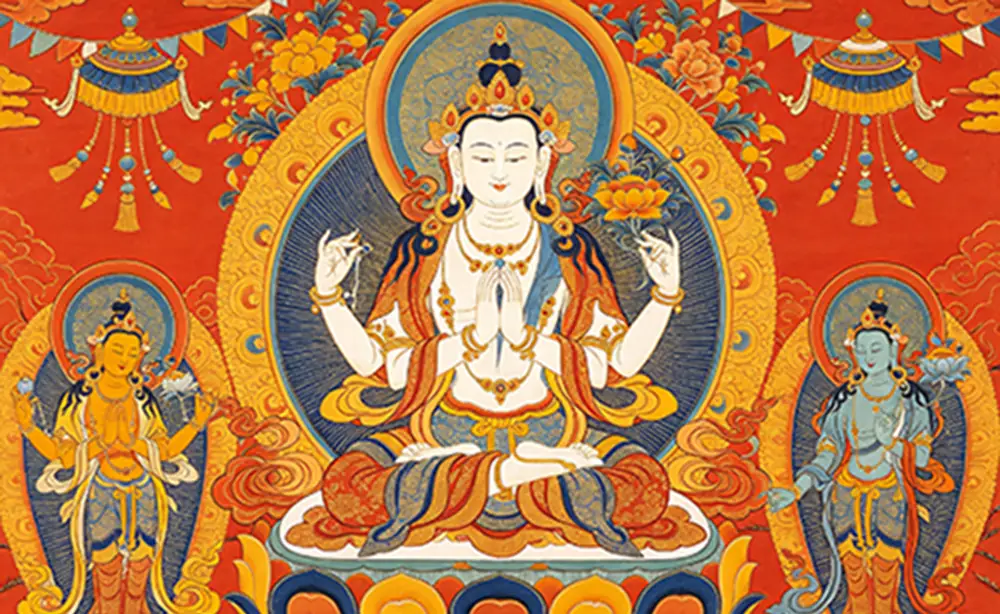
The four arms of Chenrezig are not mere artistic convention — each arm carries a universe of spiritual meaning, operating on two complementary levels.
The Four Enlightened Activities
- Pacification : The power to calm suffering, remove obstacles, and dissolve inner and outer hardships for all beings.
- Enrichment : The power to increase blessings, deepen wisdom, extend longevity, and cultivate abundance.
- Magnetizing : The power to attract beings toward liberation once one has attained spiritual freedom.
- Subjugation : The power to eliminate destructive thoughts and subdue the inner and outer demons that obstruct awakening.
The Four Immeasurable Qualities
- Immeasurable Loving-Kindness : Wishing unconditional happiness for all living beings.
- Immeasurable Compassion : Feeling profound empathy for the suffering of others and the sincere wish to relieve it.
- Immeasurable Joy : Rejoicing wholeheartedly when beings are liberated from pain and filled with happiness.
- Immeasurable Equanimity : Releasing all attachment and discrimination, meeting every being with equal openness.
What Does Chenrezig Hold in His Hands?
His first two hands are pressed together at his heart in the anjali mudra, cradling a radiant wish-fulfilling jewel (Chintamani) — a symbol of his vow to fulfill the deepest spiritual aspirations of all beings. His remaining two hands hold:
- A lotus flower in the left hand — representing purity arising untainted from the mud of samsara.
- A crystal prayer mala (rosary) in the right hand — symbolizing his ceaseless, tireless dedication to liberating every single sentient being across all realms of existence.
Om Mani Padme Hum — The Mantra of Compassion
The heart mantra of Four-Armed Avalokiteshvara is the world-renowned Six-Syllable Mantra: "Om Mani Padme Hum" . Recited by millions across Tibet, Nepal, Bhutan, and beyond, this mantra is considered the distilled essence of all Buddhist teachings. Each syllable purifies a specific realm of suffering:
- Om — purifies pride and the realm of gods
- Ma — purifies jealousy and the realm of demi-gods
- Ni — purifies desire and the human realm
- Pad — purifies ignorance and the animal realm
- Me — purifies greed and the realm of hungry ghosts
- Hum — purifies anger and the hell realms
Regular recitation of "Om Mani Padme Hum" is believed to remove karmic obstacles accumulated over countless lifetimes, sharpen wisdom, and gradually open the heart to boundless compassion — the very qualities embodied by Chenrezig himself.
The Role of Four-Armed Avalokiteshvara in Tibetan Culture
Avalokiteshvara's influence in Tibet goes beyond religion — it is cultural, historical, and mythological. Ancient Tibetan legends hold that the Tibetan people themselves are descendants of the union between a divine monkey (an emanation of Avalokiteshvara) and a mountain demoness. According to this sacred origin story, it was Avalokiteshvara who guided the divine monkey to allow humanity to flourish in the snowy highlands, and who later spread grain seeds to teach early Tibetan ancestors the art of agriculture.
Within the Three Lords of the World — Avalokiteshvara, Manjushri, and Vajrapani — Avalokiteshvara represents compassion, Manjushri represents wisdom, and Vajrapani represents power. Together they form the spiritual foundation of Vajrayana Buddhism.
Spiritual Benefits of Wearing a Four-Armed Avalokiteshvara Thangka Pendant
A hand-painted Four-Armed Avalokiteshvara Thangka Pendant Necklace is far more than a piece of spiritual jewelry — it is a portable sacred object, a wearable reminder of compassion, and a vessel for blessings.
Protection and Healing
Chenrezig's compassion is said to form a protective aura around the wearer. Each of his four arms channels a distinct quality of divine grace — calming, enriching, magnetizing, and subduing — offering comprehensive spiritual protection against negativity and harm.
Enhanced Wisdom and Clarity
As the bodhisattva associated with seeing clearly (his very name Avalokiteshvara translates as "the Lord who gazes upon the world"), wearing his image is believed to sharpen intuition, deepen understanding, and provide spiritual guidance through life's complexities.
Liberation from Suffering
Avalokiteshvara's supreme vow — to liberate every sentient being from the cycle of suffering before entering nirvana himself — infuses his image with profound spiritual power. Wearing his thangka is believed to invoke his blessings, drawing the wearer closer to peace, joy, and ultimate liberation.
A Daily Reminder to Practice Compassion
Perhaps most practically, the pendant serves as a tangible reminder throughout the day to meet others with kindness, patience, and an open heart — embodying Chenrezig's own inexhaustible compassion in everyday interactions.
Four-Armed Avalokiteshvara and the Chinese Zodiac
In Tibetan Buddhist tradition, each Chinese zodiac sign is under the protection of a specific Buddha or Bodhisattva. For those born in the Year of the Rat (1924, 1936, 1948, 1960, 1972, 1984, 1996, 2008, 2020), Avalokiteshvara is the guardian Buddha. People born under this sign are believed to benefit especially from Chenrezig's compassionate protection, receiving guidance in overcoming their life's unique challenges.
Frequently Asked Questions About Four-Armed Avalokiteshvara
What does "Chenrezig" mean?
"Chenrezig" is the Tibetan name for Avalokiteshvara and translates roughly as "one who always looks upon all beings with compassion."
What is the difference between Guanyin and Avalokiteshvara?
Both are the same bodhisattva of compassion. In Chinese Buddhism, Guanyin evolved into a female form symbolizing maternal compassion, while in Tibetan Buddhism, Avalokiteshvara (Chenrezig) is typically depicted in male form. The spiritual essence — boundless compassion for all beings — is identical.
Can non-Buddhists wear a Chenrezig pendant?
Yes. The Four-Armed Avalokiteshvara thangka pendant is worn by people of all backgrounds as a symbol of compassion, protection, and mindful living. Respect for its sacred origins is always appreciated.
The serene gaze of Four-Armed Avalokiteshvara — white body luminous with purity, hands cradling the wish-fulfilling jewel — continues to turn lovingly toward all beings across all of time and space. In wearing his image close to your heart, you carry that compassion with you, step by step, into the world.